UCSC Genome Browser · Tutorial 4

Clinical case studies

Real diagnostic variants, worked live on the Browser

Coding · splicing · non-coding · structural & repeat · genome.ucsc.edu

How these case studies work

  • Each case is a real diagnostic variant saved as a live UCSC session — open it and follow along.
  • They are grouped by variant class: coding, splicing, non-coding/regulatory, and structural/repeat.
  • The recurring move: pick the right Recommended Track Set, then read the evidence off the stacked tracks.
  • Cases contributed by clinical collaborators (credited per slide); sessions are public.
Builds on Tutorial 3 Tutorial 3 introduced the tracks and Recommended Track Sets; here we put them to work on one variant after another.

Coding variants

read the call — then check the transcript

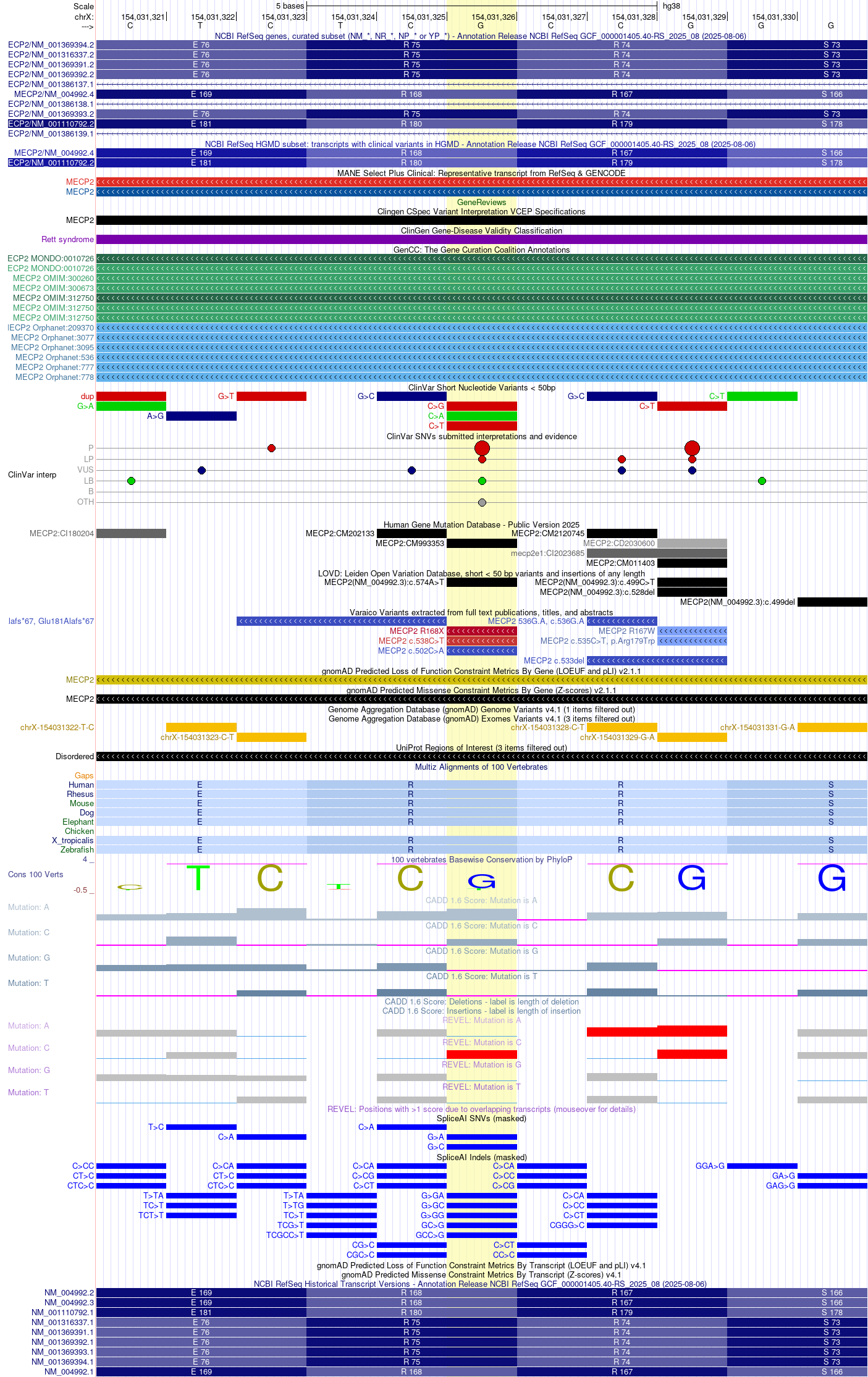
MECP2 — Rett syndrome

NM_001110792.2(MECP2):c.538C>T p.Arg180Ter (R168X) chrX

  • X-linked neurodevelopmental disorder; a classic loss-of-function nonsense variant.
  • You can paste the HGVS expression straight into the position box and press Enter.
Read it off the set Load the Clinical SNVs Recommended Track Set: ClinVar, HGMD and LOVD stack the pathogenic evidence at the codon.
Try it, ▶ open the session Paste the HGVS, then open Recommended Track Sets → Clinical SNVs.

Session: s/Max/rett

MECP2 Rett-syndrome nonsense variant on hg38
MECP2 nonsense variant with ClinVar / HGMD / LOVD tracks

MAP2K2 — a small missense

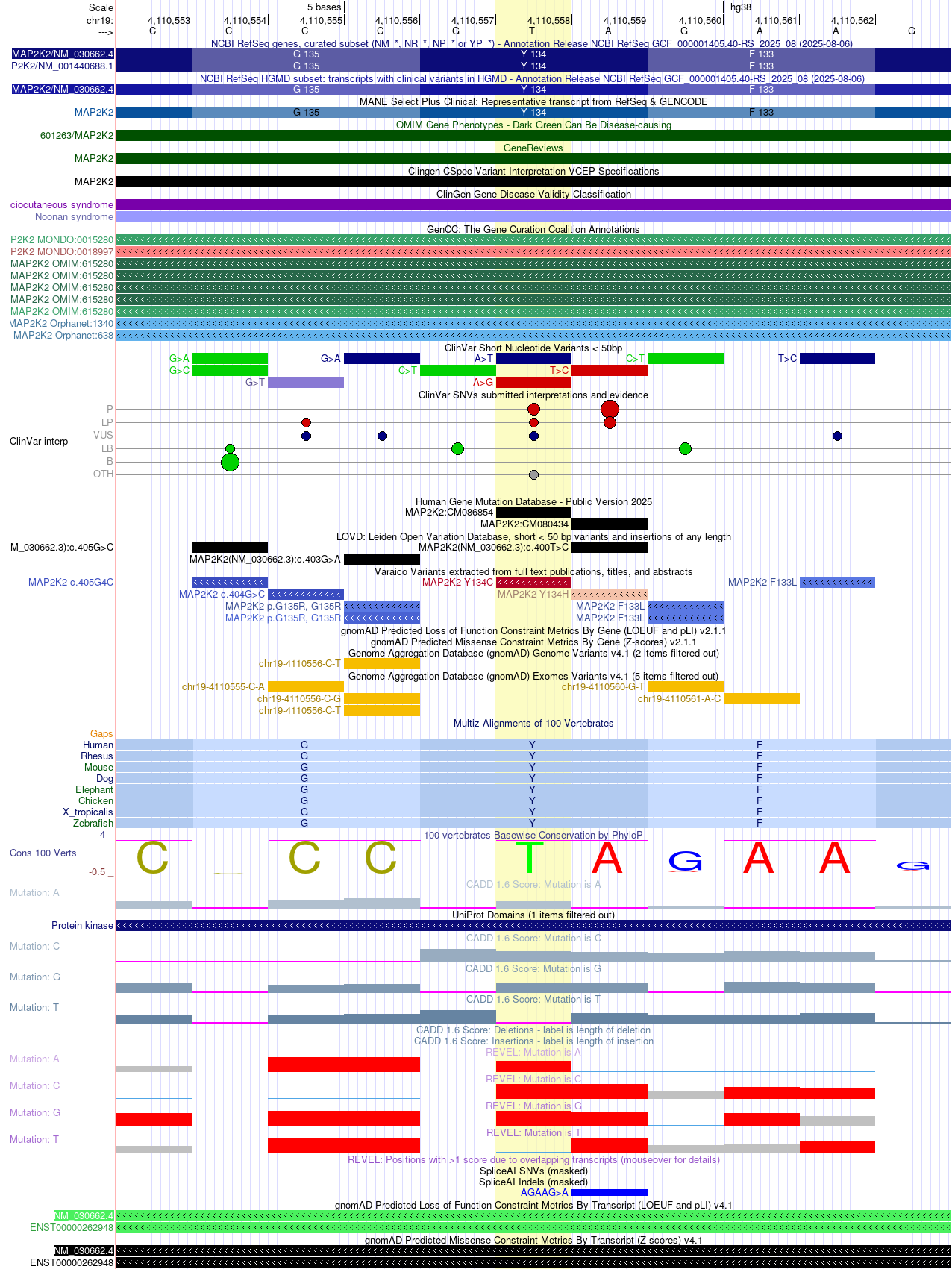
NM_030662.4(MAP2K2):c.401A>G p.Tyr134Cys

  • A RASopathy-gene missense change — the everyday coding question.
  • The SNV Recommended Track Set is on display here.
Lines of evidence ClinVar submitted interpretations & evidence, plus Varaico literature annotations for Y134C, sit together in one view.
Try it, ▶ open the session Read the ClinVar interpretations and the Varaico annotation for Y134C.

Example session (variant via Marina Di Stefano, Broad Institute)

MAP2K2 c.401A>G missense on hg38
MAP2K2 Y134C missense with SNV Recommended Track Set

Read the annotation carefully

when a coding call isn't what it seems

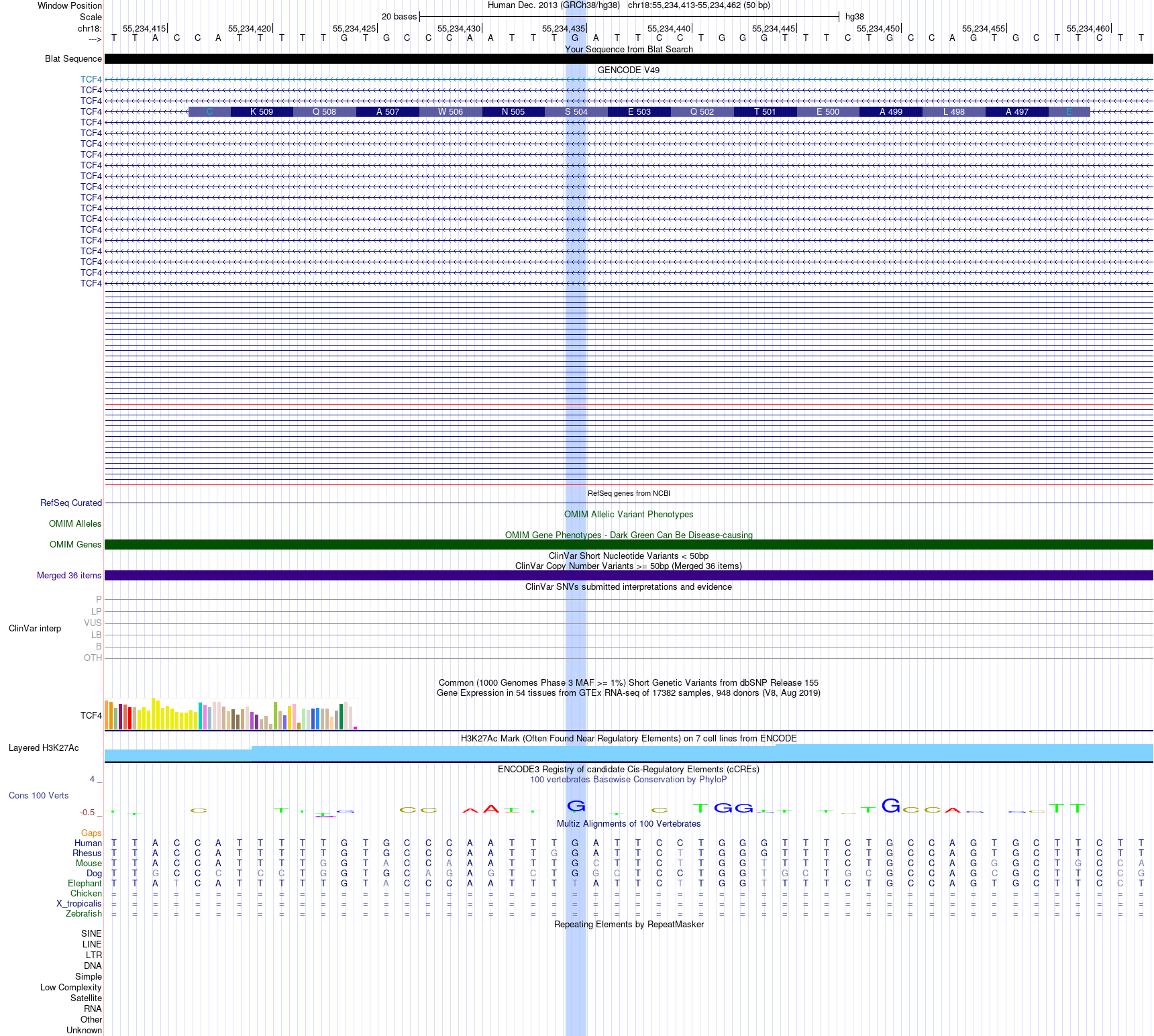
TCF4 — but do you trust this exon?

p.Ser504Ter chr18:55,234,435G>T ENST00000635822.2

  • Gene implicated in a syndromic intellectual disability; this looks like a stop-gain.
  • But the exon is coding only in one transcript, and it is not conserved across vertebrates.
The catch If the exon is not a real coding region, the “nonsense” call collapses — the variant is most likely benign. Always check the transcript and conservation.
Try it, ▶ open the session Compare transcripts; read the 100-vertebrate conservation over this exon.

Case: Irina Giurgea, Hôpital Trousseau

TCF4 variant in a non-conserved exon on hg38
TCF4 apparent stop-gain in a non-conserved, transcript-specific exon

Splicing

synonymous and deep-intronic variants that still break splicing

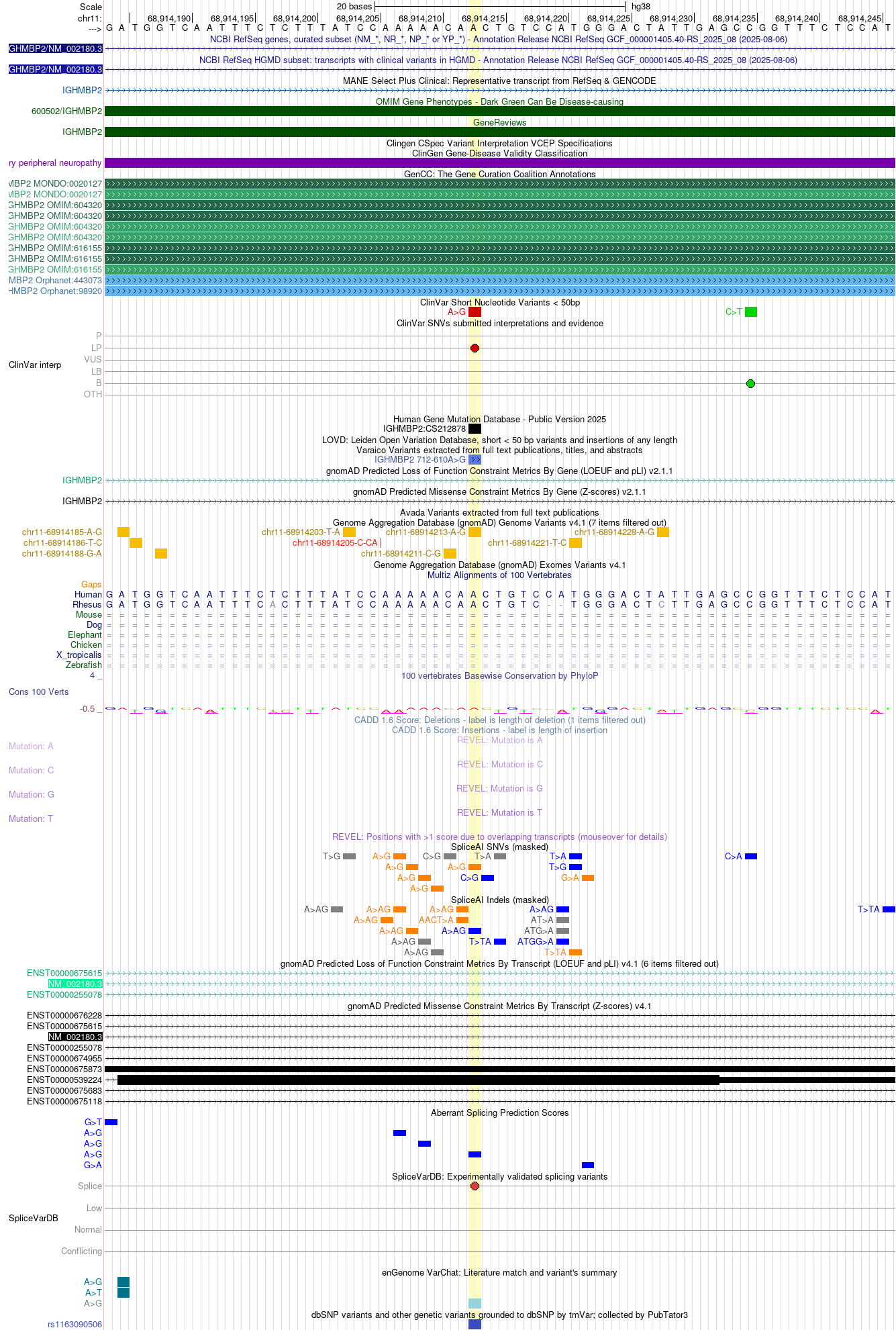
IGHMBP2 — a new splice site deep in an intron

NM_002180(IGHMBP2):c.712-610A>G hg38 chr11:68,914,208

  • A variant deep in an intron, far from any coding exon — easy to dismiss.
  • But it can create a new splice site.
Scan the predictors The Splicing Impact / SpliceAI track flags the gain; SpliceVarDB and a PubTator hit corroborate it.
Try it, ▶ open the session Turn on Splicing Impact; inspect the SpliceAI delta scores at the variant.

Session: s/Max/ighmbp2.712 · PMID 33189025

IGHMBP2 deep-intronic splice variant on hg38
IGHMBP2 deep-intronic variant with SpliceAI / Splicing Impact

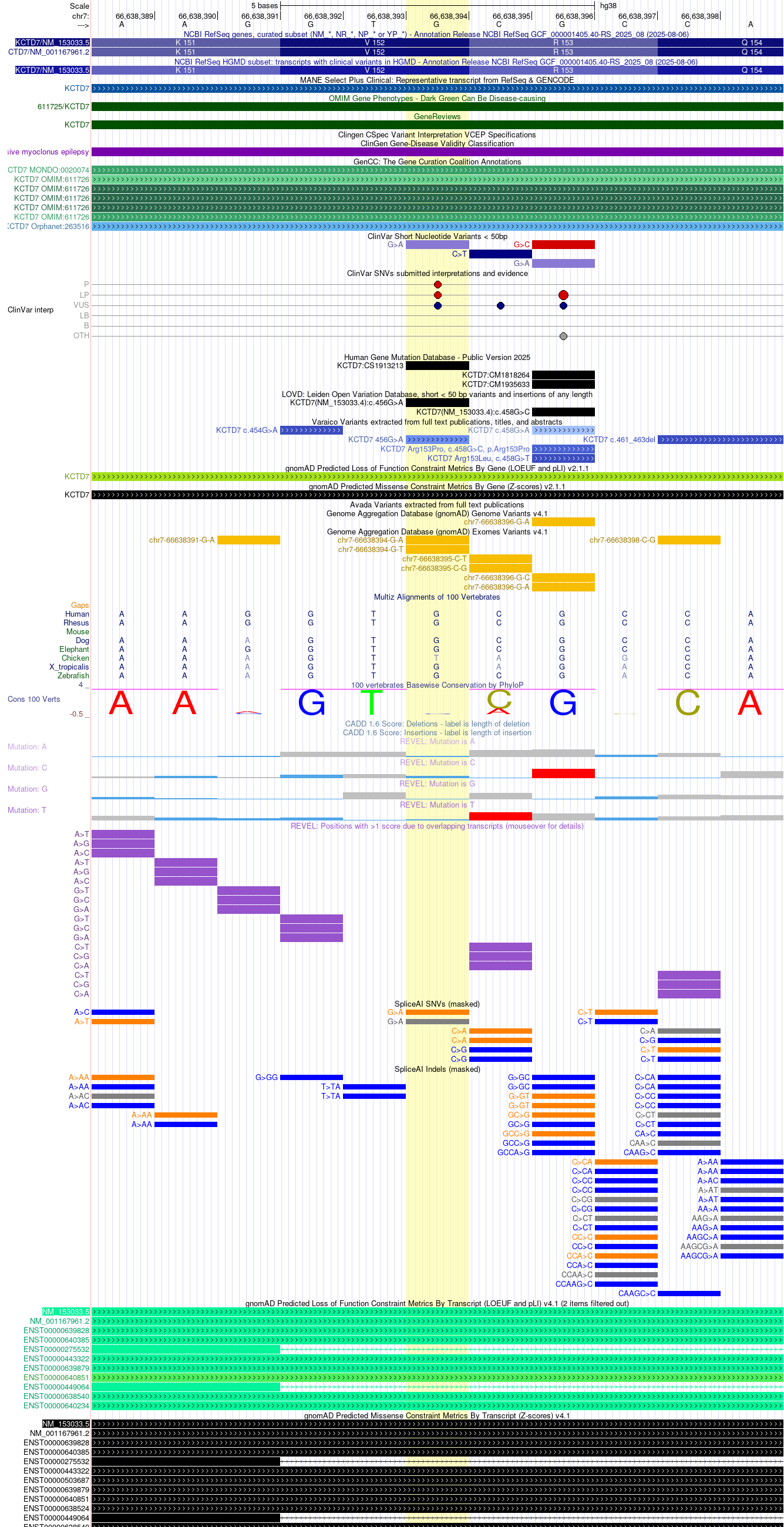
KCTD7 — a synonymous variant that isn't silent

KCTD7:c.456G>A p.Val152Val exon 3

  • A synonymous change — no amino-acid change, so it looks harmless.
  • But it disrupts splicing.
Synonymous ≠ silent The Splicing Impact track shows the effect; the variant is in the LOVD of a 2019 paper from the same lab.
Try it, ▶ open the session Check the splicing predictions over this synonymous position.

Session: s/Max/kctd7.456GA · PMC10506157

KCTD7 c.456G>A synonymous splice-affecting variant on hg38
KCTD7 synonymous variant predicted to affect splicing

Non-coding & regulatory

enhancers, promoters and RNA genes

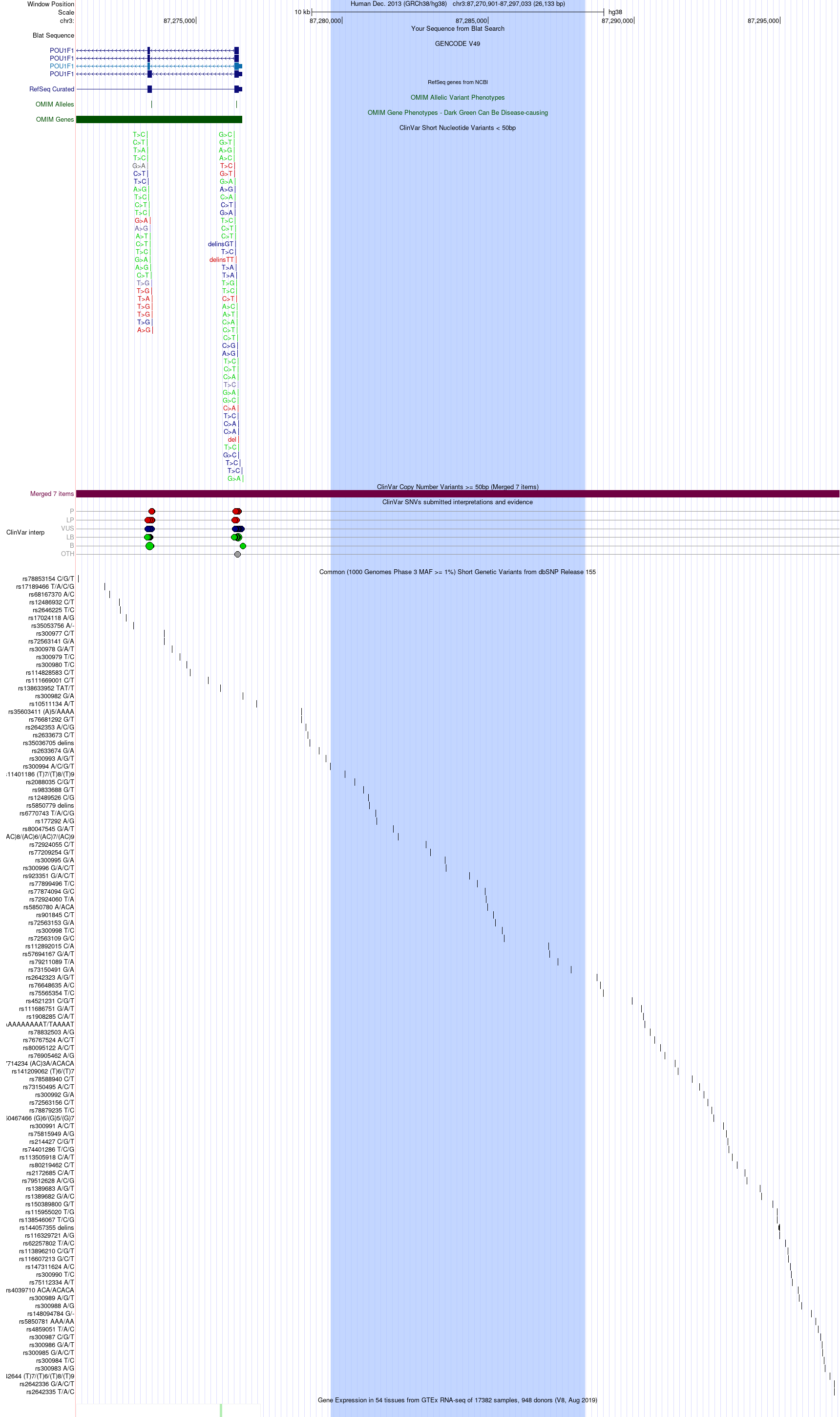
POU1F1 — a deletion upstream of the gene

8.7 kb deletion, ~3 kb upstream hg38 chr3:87,279,612-87,288,322

  • Homozygous deletion upstream of POU1F1, a pituitary transcription factor (pituitary hormone deficiency).
  • No coding sequence is touched — the evidence is regulatory.
Read the regulation The deletion removes an ENCODE cCRE with a distal-enhancer signature; conservation and GTEx (pituitary +++) support its role.
Try it, ▶ open the session Turn on ENCODE cCREs, 100-vertebrate conservation, and GTEx over the deleted region.

Case: Amselem & Legendre labs, Hôpital Trousseau

POU1F1 upstream regulatory deletion on hg38
POU1F1 upstream deletion overlapping a distal-enhancer cCRE

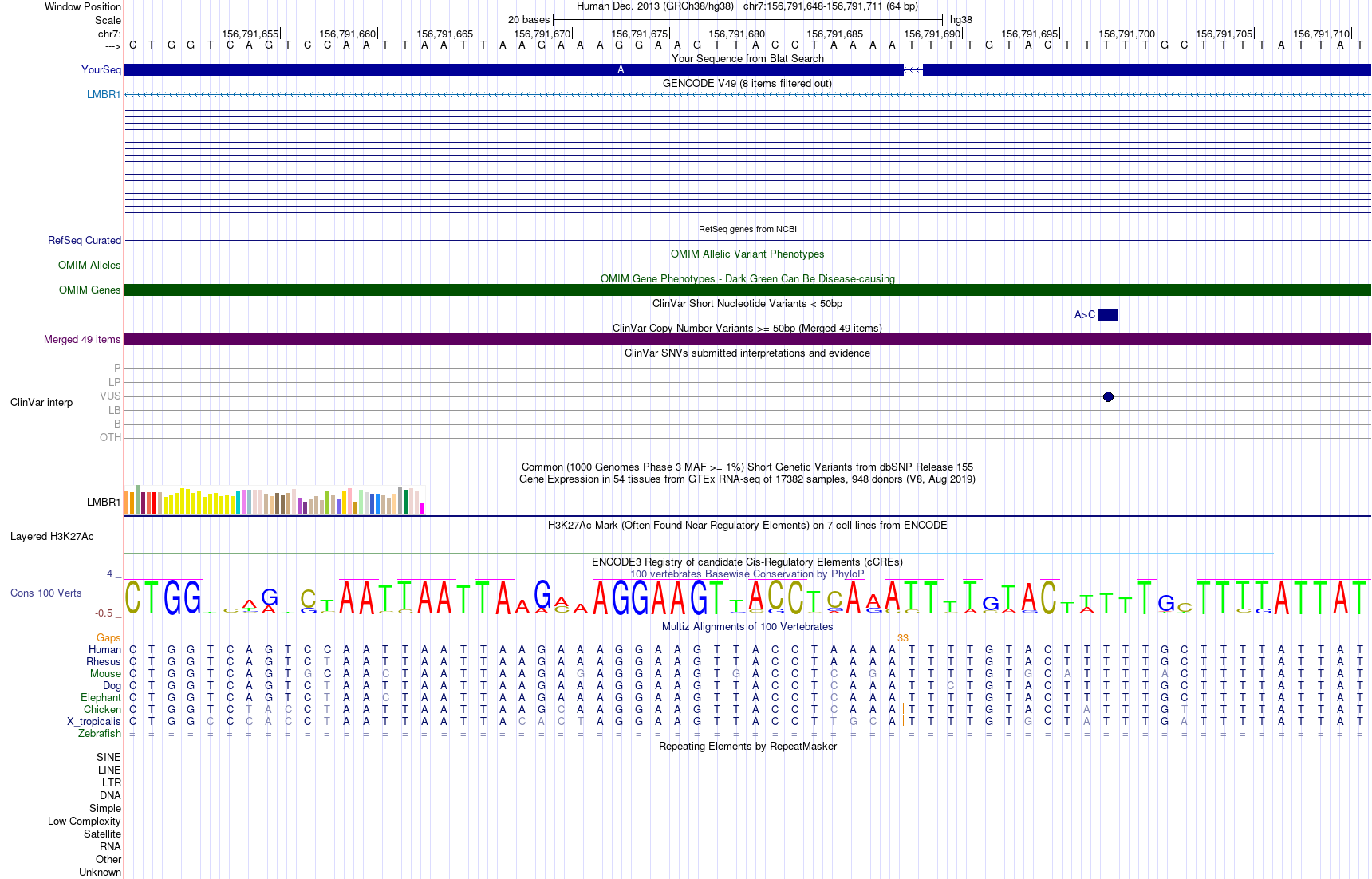
SHH / ZRS — a limb enhancer in an intron of LMBR1

Patient chr7:156,791,472C>T intron 5 of LMBR1 (the ZRS)

  • The ZRS is a classic long-range enhancer of SHH; variants in it cause limb malformations.
  • In snakes, a 17 bp ZRS deletion contributed to limb loss (Kvon et al.).
Motif in an enhancer BLAT the snake sequence and Short Match the ETS1 motif; the patient variant sits in a conserved ETS motif inside a distal-enhancer cCRE, with other OMIM-allele patients nearby.
Try it, ▶ open the session Use BLAT / Short Match for the ETS motif; read the cCRE, conservation and OMIM alleles.

Cases: Wieczorek et al. 2009; snake example: Kvon et al.

SHH ZRS enhancer variant in LMBR1 intron 5 on hg38
The ZRS limb enhancer with ETS motif, cCRE and conservation
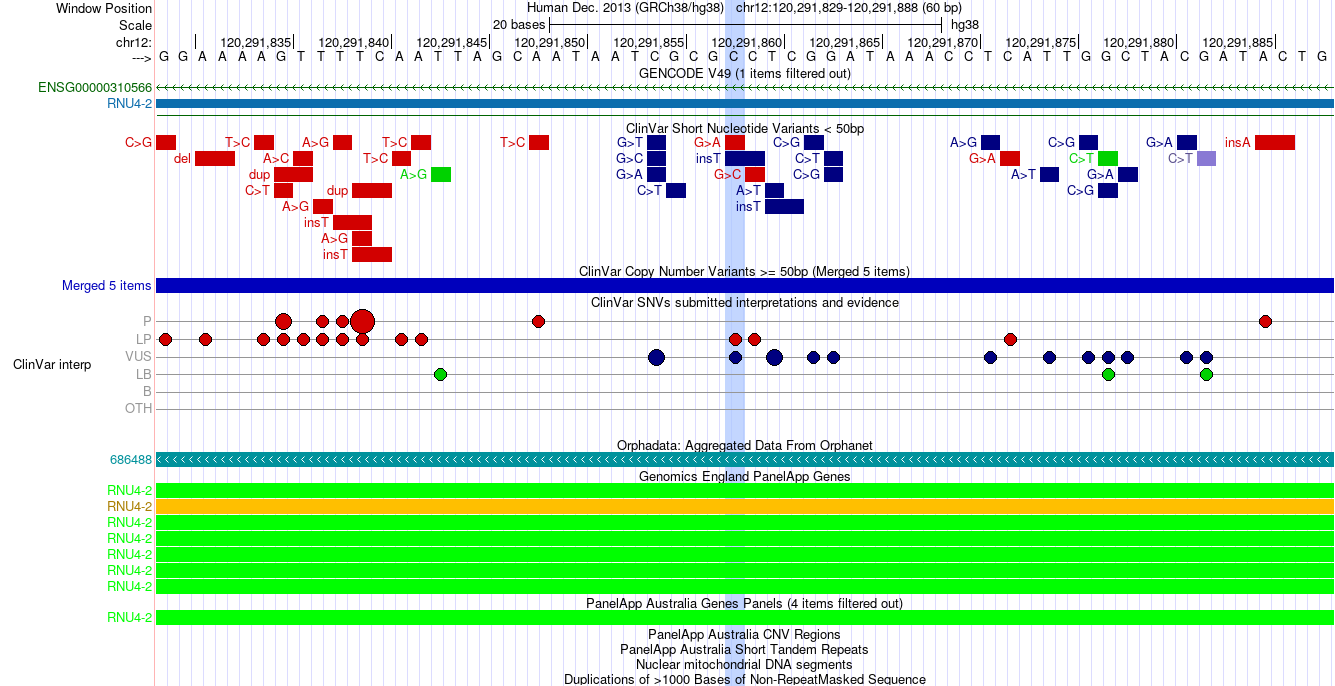
RNU4-2 — a variant in a non-coding RNA gene

hg38 chr12:120,291,858 C>T RNU4-2 (NR_003137.3):n.46G>A

  • RNU4-2 encodes the U4 spliceosomal snRNA — a non-coding RNA gene, not a protein.
  • Recently (2024) shown to cause one of the most common monogenic neurodevelopmental disorders (ReNU syndrome).
No protein here There is no coding consequence to read; you reason from the RNA gene itself and the recent literature.
Try it, ▶ open the session View the variant within the RNU4-2 gene body; a second hotspot sits at n.129G>A.

Case: Jon Bernstein · medRxiv 2025

RNU4-2 snRNA-gene variant on hg38
RNU4-2 non-coding RNA-gene variant on hg38

Structural & repeat

CNVs and repeat expansions

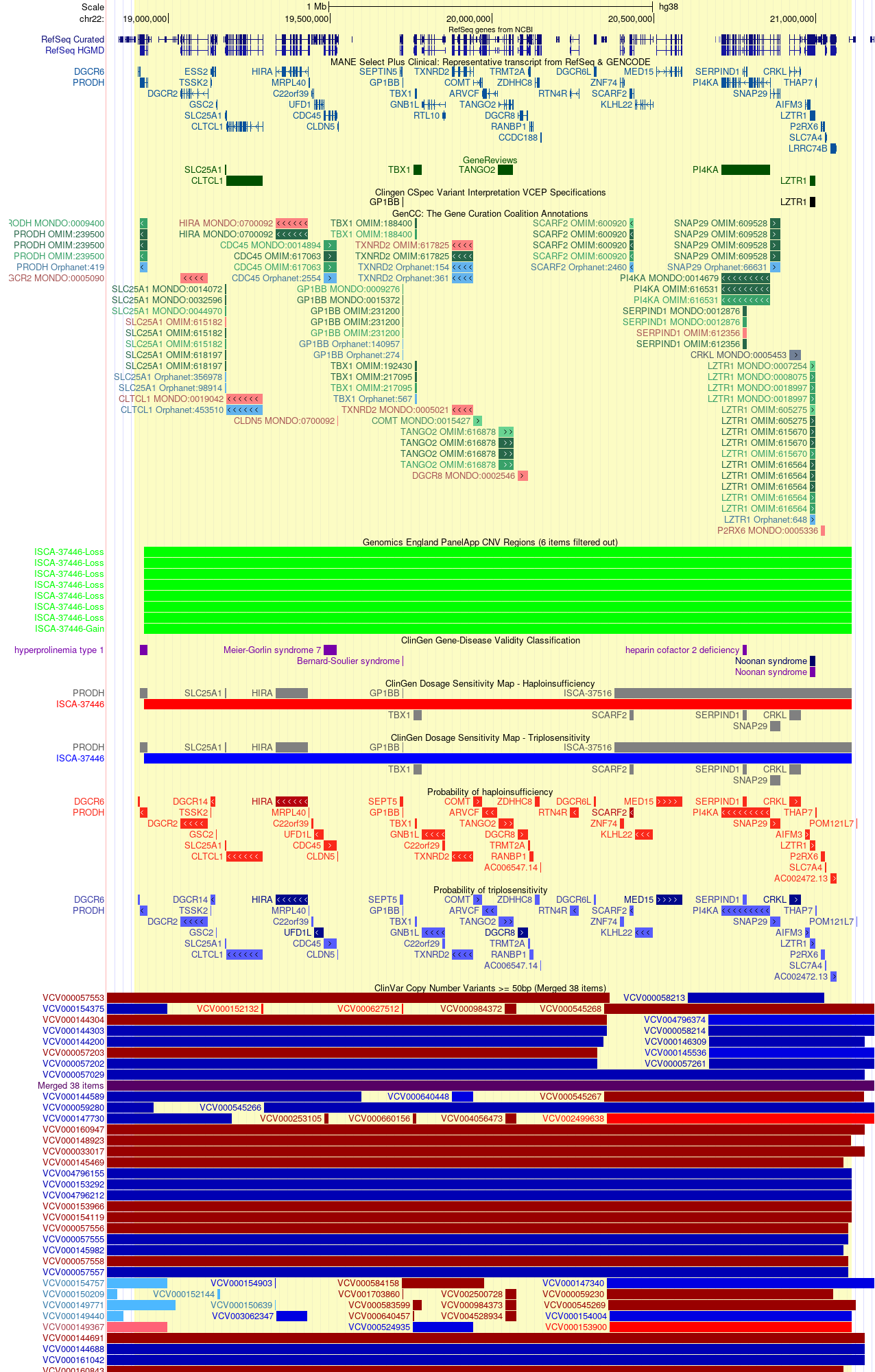
A 2.22 Mb duplication on chromosome 22

chr22:g.18,895,798-21,111,753dup GRCh38 2.22 Mb

  • A large copy-number gain at 22q11.2 — a different interpretation problem from SNVs.
  • Load the CNV Recommended Track Set.
CNV-specific evidence ClinGen Dosage (triplosensitivity), ClinVar CNVs, DECIPHER and PanelApp CNV regions — each filterable.
Try it, ▶ open the session Load the CNV RTS; compare the duplication against ClinGen Dosage and DECIPHER.

Example session

chr22 2.22 Mb duplication on hg38
A 2.22 Mb duplication with ClinGen Dosage, ClinVar CNVs, DECIPHER and PanelApp

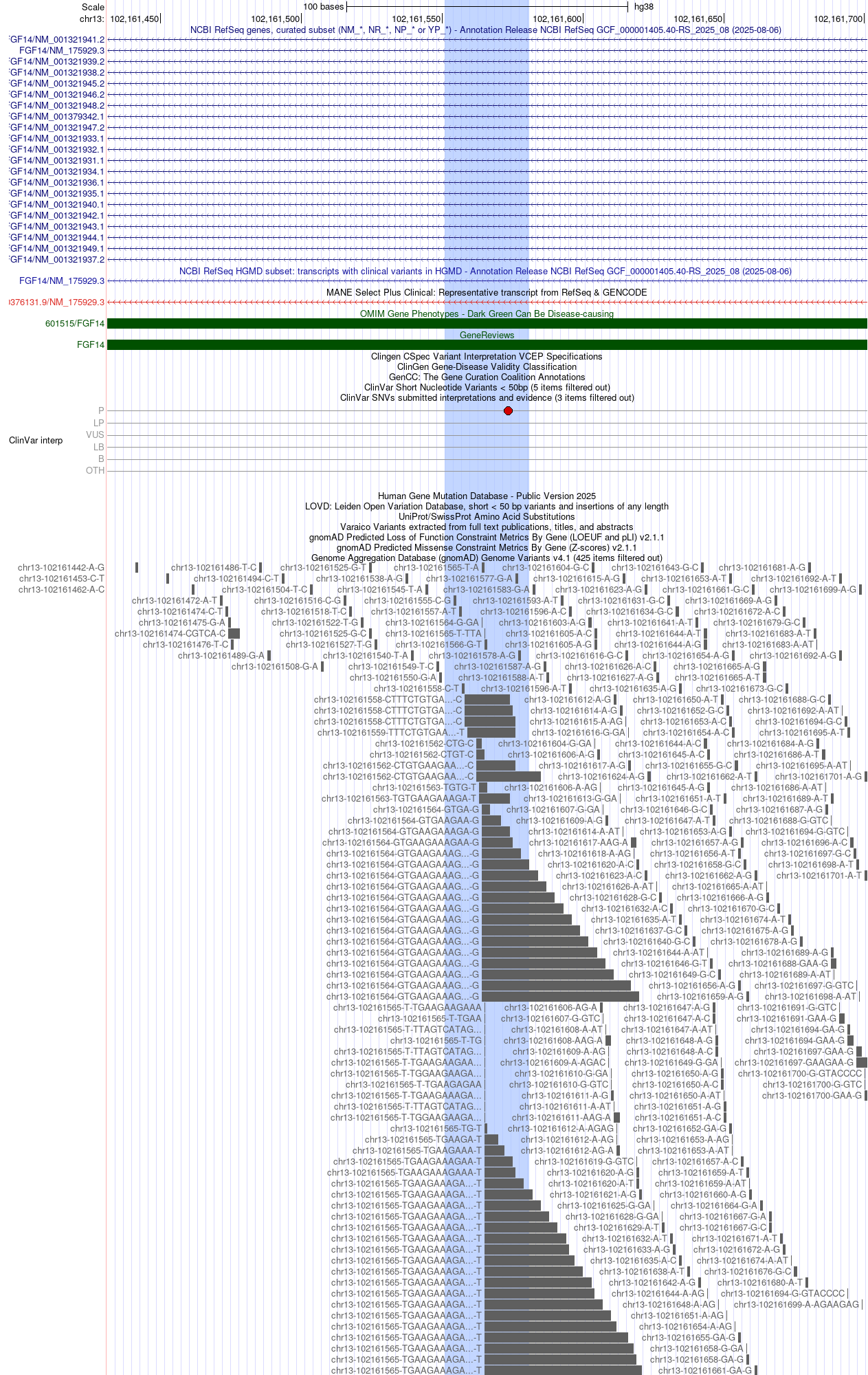
FGF14 — a GAA repeat expansion

FGF14 intron 1 hg38 chr13:102,161,567 ~270-300 GAA repeats

  • Late-onset cerebellar ataxia (SCA27B) caused by an intronic repeat expansion — not an SNV or CNV.
  • A distinct class of variant with its own resources.
A third variant class View the intron-1 GAA locus in the Browser, then cross-check dedicated tandem-repeat resources (WebSTR, TRatlas).
Try it, ▶ open the session Navigate to the intron-1 repeat; compare against the tandem-repeat tracks/resources.

Session: s/Max/fgf14

FGF14 GAA repeat-expansion locus on hg38
FGF14 intron-1 GAA repeat locus on hg38

More cases

a gallery of de novo neurodevelopmental variants

More cases: de novo neurodevelopmental variants

A gallery of further worked cases (GSS series) — each opens as a live session:

  • LRRC8A c.730T>C p.Phe244Leu — multisystem disorder, de novo heterozygous. session
  • KPNA4 c.557G>A p.Gly186Asp chr3:160,526,107C>T — seizures, developmental delay, autism. session
  • ERCC8 c.550+2T>C splice + a complex maternal SV — compound heterozygous, Cockayne-spectrum. session
  • RNU4ATAC n.12C>T + n.120T>G — minor-spliceosome snRNA, compound heterozygous, multisystem.
Same recipe Different genes and mechanisms, one workflow: open the session, load the right track set, read the evidence.

What these cases show

  • Coding variants can be read almost off the tracks — but always check the transcript and conservation (TCF4).
  • Synonymous and deep-intronic variants can still break splicing — scan the splicing predictors.
  • Non-coding variants are interpreted from regulatory context: cCREs, conservation, expression, TF motifs.
  • CNVs and repeat expansions are their own classes, each with dedicated tracks and resources.
The habit Turn every variant into a set of questions, then let the right track answer each one.

Thank you!

Questions? · genome@soe.ucsc.edu

UCSC Genome Browser · genome.ucsc.edu

UCSC Genome Browser team