UCSC Genome Browser · Tutorial 5
Teaching with the Browser
Ready-made, interactive modules for the classroom
~20 free modules on the Education portal · genome.ucsc.edu
The Education portal
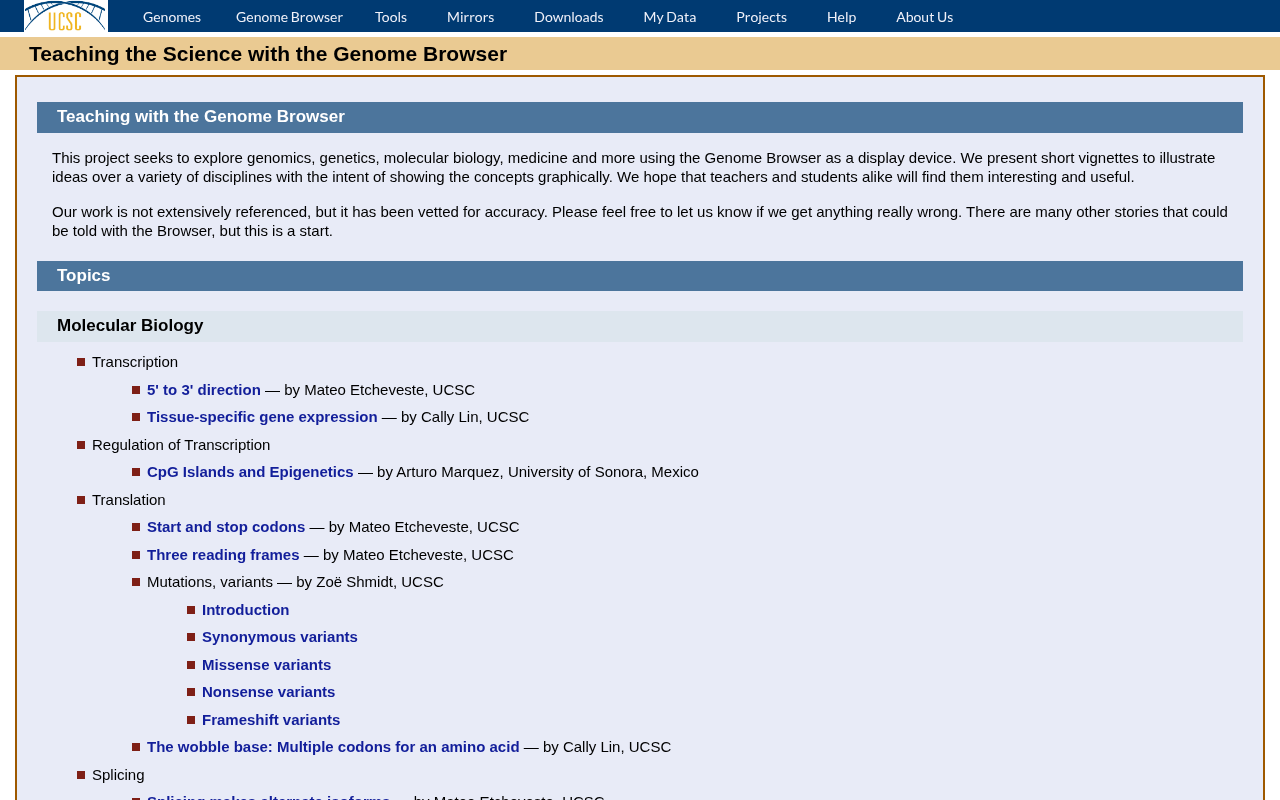
- genome.ucsc.edu/training/education: ~20 interactive modules + videos.
- Self-contained, undergraduate-level, each built on clickable Browser sessions.
- Topics: codons & reading frames, variant effects, splicing, CpG/methylation, CRISPR, Huntington’s disease, lactase, FOXP2…
Can be used as part of a lecture or assignments.
Reading the gene
the central dogma, made visible
Reading the gene, base by base
- 5′ → 3′ direction: which way a gene is transcribed open
- Start & stop codons: the signals that begin and end translation open
- Three reading frames: how one sequence can be read three ways open
Same recipe Each module is really just a saved session you can reuse, ready to drop into a lecture or assignment.
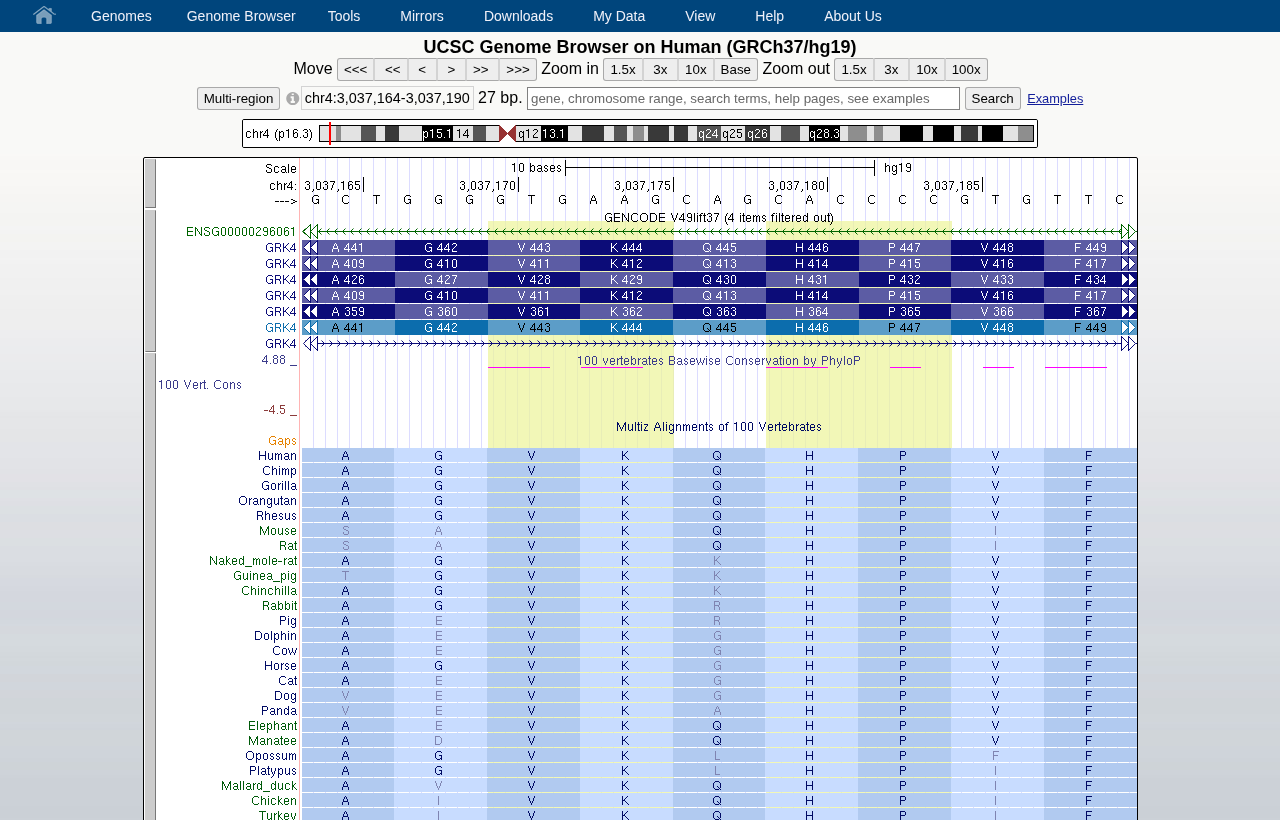
Another module: the “Wobble Base” module
- Teaches codon degeneracy: the 3rd base of a codon can change without changing the amino acid (“wobble”).
- Example: the GRK4 kinase domain (hg19), codons & amino acids drawn over the sequence.
- Read it down the 100-vertebrate alignment: the amino acid (V, K, A…) is identical across species even where the wobble base differs, and PhyloP shows those residues are conserved.
Try it, ▶ open s/education/hg19_wobble2
Find a column where a base varies between species but the amino acid stays the same.
Same recipe
Another saved session; the portal has ~20 like this.
Variants and their effects
what a change does to the protein
Variants and their effects
- Synonymous: a base change that leaves the amino acid unchanged open
- Nonsense: a change that creates a premature stop codon open
- Frameshift: an insertion or deletion that shifts the reading frame open
Same recipe Each module is really just a saved session you can reuse, ready to drop into a lecture or assignment.
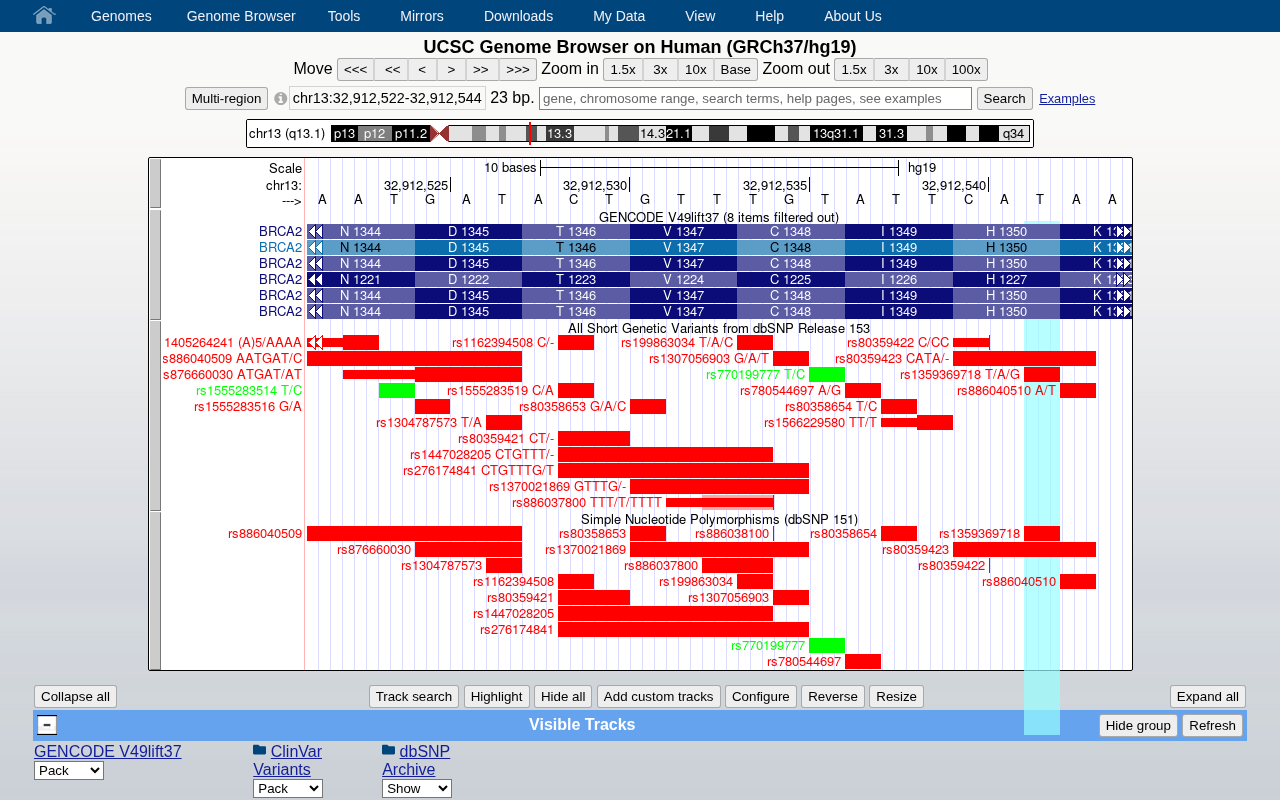
Spotlight: the “Missense Variants” module
- The Missense Variants module teaches a missense variant on the cancer gene BRCA2 (rs135936718, His→Gln).
- Open the shared link; dbSNP colors green = synonymous, red = missense.
- A nice sum-up of the basics: it reuses the gene model, codons & amino acids, and clicking a variant.
Try it
Open s/education/hg19_BRCA2missense; find the red variant.
The takeaway
A module is just a session. You’ll learn to build your own in the Sessions section of Tutorial 1.
Splicing & isoforms
one gene, many mRNAs
Bonus module: the “Splicing” module if time
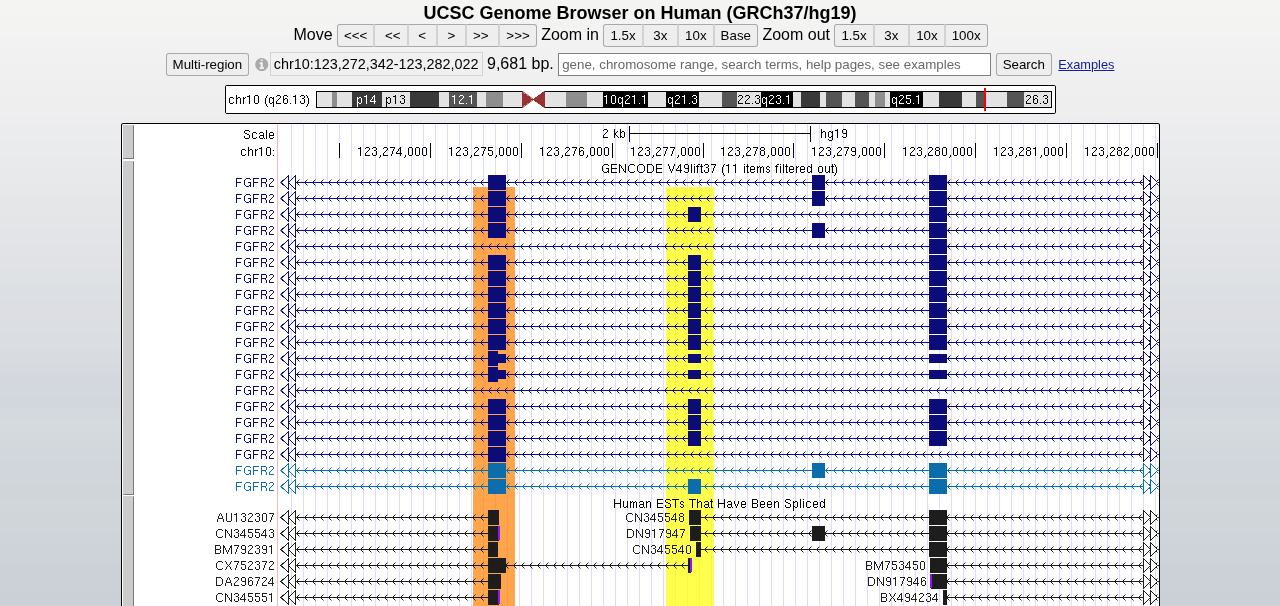
- The Splicing module teaches alternative splicing: different exon combinations make distinct mRNA isoforms.
- Example: FGFR2 (hg19), with exons included or skipped across its GENCODE isoforms.
- The Spliced ESTs (expressed sequence tags) and alternative splicing tracks show which exons each transcript version includes or skips.
Try it, ▶ open the FGFR2 session
Compare isoforms across the two highlighted exons.
Same recipe
Another saved session, one of ~20 ready-made modules.
Isoforms and tissues
- Isoforms across tissues: tissue-dependent alternative splicing open
- Tissue-specific expression: where a gene is switched on (the PLP gene) open
Same recipe Each module is really just a saved session you can reuse, ready to drop into a lecture or assignment.
Spotlight: tissue-specific expression
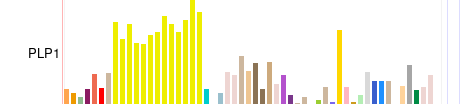
- The GTEx track shows how strongly a gene is expressed across 54 human tissues: one colored bar per tissue.
- Example: PLP1, a myelin gene, is switched on almost only in the brain (the tall yellow bars).
- A quick, visual way to ask “where is this gene active?”
Try it, ▶ open PLP1 with GTEx
Read which tissues light up for this gene.
Same recipe
Another saved session, one of ~20 ready-made modules.
Regulation & epigenetics
beyond the coding sequence
Regulation & epigenetics
- CpG islands & methylation: DNA methylation and epigenetic regulation open
- CRISPR: gene editing, explored in the Browser open
Same recipe Each module is really just a saved session you can reuse, ready to drop into a lecture or assignment.
Disease & evolution case studies
genetics with a story
Case studies: disease
- Huntington’s & CAG repeats: a trinucleotide-repeat expansion in HTT open
- Lactase persistence (LCT): the genetics of digesting milk open
- Alcohol intolerance: variation in alcohol metabolism in East Asians open
Same recipe Each module is really just a saved session you can reuse, ready to drop into a lecture or assignment.
Case studies: evolution
- FOXP2 & the evolution of speech: comparing a speech gene across species open
- Why apes have no tails: an evolutionary loss, seen in the genome open
- Ebola & Marburg conservation: conserved regions of viral genomes open
Same recipe Each module is really just a saved session you can reuse, ready to drop into a lecture or assignment.
Spotlight: why apes have no tails
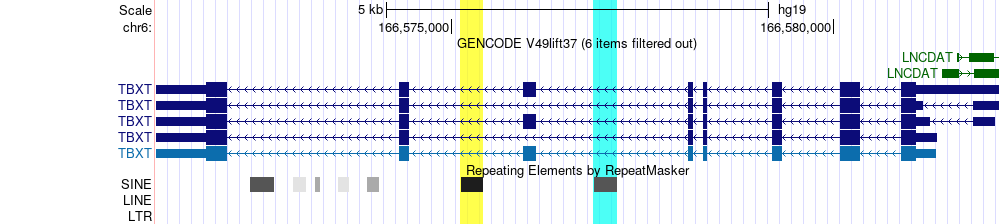
- An Alu insertion (a “jumping-gene” element) landed inside the tail-development gene TBXT in the common ancestor of apes.
- It makes an exon get skipped, altering the protein, and this is linked to the loss of the tail.
- The RepeatMasker track marks the Alu (highlighted); the GENCODE isoforms show the affected exon.
Try it, ▶ open s/education/hg19_TBXTalus
Find the highlighted Alu element inside the TBXT gene.
Same recipe
Another saved session, one of ~20 ready-made modules.
Bringing it into the classroom
- Around 20 self-contained modules, each built on a clickable Browser session.
- They span the central dogma (reading frames, codons, splicing), variant effects, and real disease & evolution case studies.
- Use them as lecture demos or student assignments, with no install required.
- Build your own the same way: save a session (see Tutorial 1) and wrap it in a page.
Try it Browse the full library at genome.ucsc.edu/training/education.
Thank you!
Questions? · genome@soe.ucsc.edu
UCSC Genome Browser · genome.ucsc.edu